Subscribe by Email

Your email:

SOCIAL IMPACT STUDY  
socialimpactdownload_blog_200wide  
1088-person consumer survey on the influence of social sharing on consumer purchase  

Influence of Social Sharing on Consumer Purchase

download_1-164

Follow Me

sociable marketing blog graphic

Current Articles | RSS Feed RSS Feed

Facebook Permissions Authorization Rates Remain High Despite Privacy Concerns


2012 was a year of significant changes to Facebook’s sharing policy.  Initiatives such as Open Graph Publishing and Seamless Sharing raised concerns from the public and the media that Facebook users would resist the increase in automated sharing on their behalf, particularly around authorizing Facebook Connect with third party applications.

At Sociable Labs, we last studied Facebook Permissions authorizations in December 2011, before Facebook’s most recent raft of changes, and we thought it would be insightful to revisit the question a little over a year later.  The question we examined is “What percentage of users will accept a Facebook Permissions authorization prompt and how has that figure changed in the last year?” Our research indicates that there has been no meaningful change in authorization rates in the last year, with an average rate across our customers of just under 60%.

claires fb permissions

Methodology

Data for the study was collected with Facebook Insights using all Sociable Labs customers that had deployments of Sociable applications on their websites in both 2011 and 2012. We compared accept rates during the one-month period from 19 November to 18 December of both 2011 and 2012 to determine if there had been a meaningful change in the rate at which users authorize Facebook Permissions prompts. Averages were calculated as the ratio of total accepts to total impressions, summed across all customers.

Additionally, we calculated acceptance rates for all Sociable Labs customers for whom data was available during the last 12 months, again using data collected with Facebook Insights. For this same period, we also calculated the acceptance rate when the authorization was being used for registration only.

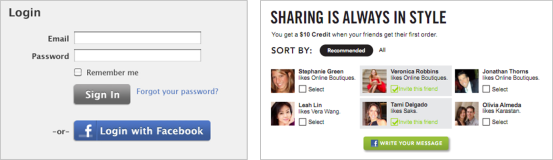
Facebook Authorization Screen on Claires.com

Results

During a one month period spanning November and December, there was no significant change in Facebook Permissions acceptance rate between 2011 and 2012. The 2011 accept rate was 55.6% and the 2012 rate was 56.6%. Total impressions during these periods was just under 400,000.

Overall acceptance rate for the entire 12-month period from December 2011 to December 2012 for all Sociable Labs customers for whom data was available is marginally higher at 59.4% of nearly 3.8 million permission request impressions.

Permissions for Registration Only

When the authorization was requested for site registration only, as employed for “Login with Facebook”, the accept rate rose to 68.8%. The actual accept rates are even higher when discounting one outlying customer that had an abnormally low acceptance rate but accounted for a significant portion of the data (30.8% of all impressions for the period).  Therefore, the nonweighted average of all customer acceptance rates, 75.7%, is a more realistic picture of the acceptance rate when permissions are requested solely for the purpose of using Facebook for site registration.

claires login resized 600

Conclusion

The results show that despite growing concerns about privacy on Facebook, particularly as sharing becomes more automated, users are continuing to authorize Facebook Permissions at high rates. Compared to one year ago, the current rates are about a percent higher during a one month period, and over the last year in its entirety, authorization rates are nearly 60%, and more like 75% if the permissions are requested only those required for the purpose of “Login with Facebook” in lieu of creating a site password.


This finding is promising because it indicates that the fundamental premise of social commerce, that users are willing to share personal social data with online retailers, is a) sound and b) relatively inelastic. That is, even in the face of controversy surrounding Facebook’s evolution of how social information is shared, users seem unfazed and are still willing to authorize permissions. It is worth noting that, as always, good user flows, application design, and a clear benefit to the user will incentivize them to authorize permissions.

Study on Log In with Facebook and the 2012 Internet Retailer 500


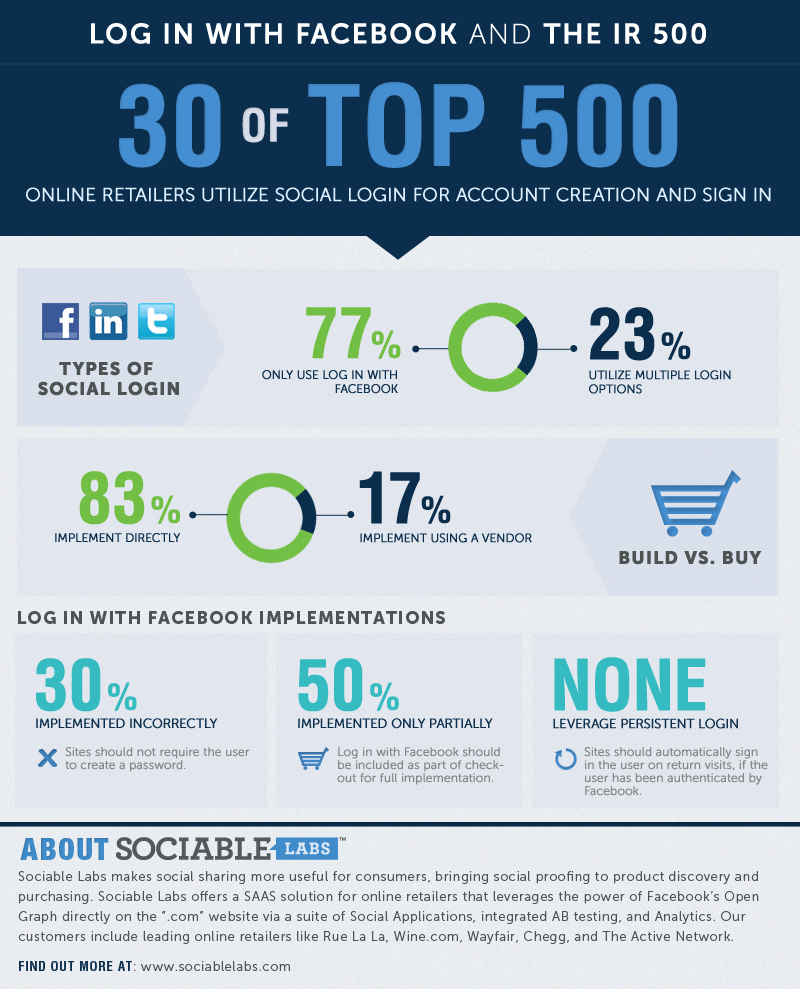
Today we released a research study that we believe will be very helpful for any online retailer who is considering implementing Log In with Facebook.  In particular, we reviewed how the top 500 online retailers integrated Log in with Facebook as an alternative option for their account creation, site registration, and site login processes. Sociable Labs’ study of Log in with Facebook usage by the IR 500 was restricted to this use case only — simply whether Log in with Facebook is integrated with the core e-commerce site for user account creation. Sociable Labs did not study other use cases for Facebook Platform, such as Social Plugins (i.e. Like buttons) or other onsite social applications that utilize Log in with Facebook.

Sociable Labs found that adoption of Log in with Facebook by the IR 500 is still in its beginning stages with 30 of the top 500 online retailers having implemented Log in with Facebook into their account creation process today. This remains an untapped opportunity area for most of the IR 500, who have yet to take advantage of the many benefits that Log in with Facebook affords: simplified account creation, elimination of required site-specific passwords, increased onsite personalization, richer CRM data, and increased referral traffic from Facebook. Sociable Labs believes that the major factors hindering adoption include technical barriers to implementation, perceived security concerns, and level of effort required for implementation. Many of these barriers will be removed over time, which should spur continued adoption of Log in with Facebook by the IR 500.

Facebook is by far the dominant Social Login option chosen by these online retailers. All IR 500 sites that have implemented a Social Login solution include Log in with Facebook. Furthermore, 77% of these sites only offer Log in with Facebook. Sociable Labs believes that online retailers will continue to prioritize Log in with Facebook over other forms of Social Login (Twitter, Yahoo, Google, etc.) as Facebook continues to advance its offerings around Facebook Platform.

The majority of IR 500 sites that offer forms of Social Login other than Facebook have done so by utilizing a third-party software vendor such as Gigya or Janrain. However, only 17% of the IR 500 that have implemented Social Login have chosen to do so via a vendor. The majority of the IR 500 that have implemented Log in with Facebook have done so independent of third-party software, which is why Sociable Labs believes Facebook will remain the primary, and only, social login option offered by most online retailers.

Sociable Labs also found that a large percentage of IR 500 sites that have implemented Log in with Facebook have done so incorrectly, or are not leveraging best practices. A full 30% of those who have implemented Log in with Facebook have done it incorrectly by requiring the user to create a site password in tandem with Log in with Facebook. Exactly half of those who have implemented Log in with Facebook have yet to offer it during the checkout process, missing a big opportunity to generate more usage and provide a consistent user experience. None of the IR 500 that have implemented Log in with Facebook are taking advantage of one of the primary benefits of Log in with Facebook — Persistent Login—to automatically login users on return visits.

You can download the full study here: http://www.sociablelabs.com/download-login-study


describe the image

Sociable Labs on Bloomberg TV


Yesterday I had the honor of appearing on Bloomberg TV to discuss the impending Facebook IPO and how Facebook will grow its revenue over the coming years.  In short, I believe Facebook will one day power advertising on many websites, not just its own.  Watch the video here:

http://www.businessweek.com/videos/2012-05-16/advertising-on-facebook-in-infancy-gabbay-says  

The death of the "Social Reader" is greatly exaggerated


There has been a lot talk in the blogosphere about reported declines in utilization of so-called "Social Reader" Facebook applications, like those from the Guardian and the Washington Post.  The dip in active users has led to a lot of conjecture about OpenGraph publishing being a passing fad and one that consumers are outright rejecting.  Much of this conjecture is absolutely false, while some is just misleading.  This is how we see the facts:

1.  Reports of broad consumer rejection of Facebook seamless sharing are absolutely false.  More and more applications are growing and thriving using seamless sharing (aka OpenGraph Publishing), such as SocialCam, which grew to 40M active FB users in the course of two weeks (http://www.appdata.com/apps/facebook/150768931647055-socialcam).
 
Screen shot 2012 05 17 at 9.08.30 AM resized 600
2.  Some Social Readers that are Facebook canvas apps, have seen declines over the last month.  However, websites using seamless sharing, such as Yahoo News, have not seen any significant decline (http://www.appdata.com/apps/facebook/194699337231859-yahoo-social-bar).  We have confirmed this directly with many companies using OpenGraph publishing from their websites.  The below graph for Yahoo shows that daily monthly active usage is still in the 40M zone, ranging between 38M to 42M.
 
Screen shot 2012 05 17 at 9.11.33 AM resized 600
It is important to draw a distinction between canvas apps and onsite integration.  Onsite integration has a continuous source of organic traffic already, and hence is buffered from changes to Facebook newsfeed algorithms.  Canvas apps like Washington Post Social Reader are going to be more affected by these types of changes given their sole reliance on Facebook traffic.
 
3.  The drop-off in usage for social readers can be attributed directly to changes to the Facebook newsfeed algorithm.  The drop-off starting April 10 looks dramatic because of a substantial rise in activity end of March and early April.  Looking at the graphs holistically over a longer time horizon shows the effects of the Facebook newsfeed changes as rather minimal, relative to the total usage.  This graph from Techcrunch and AppData, show that the Guardian's daily active user count went from 200,000 to 150,000, a 25% drop, but much more reasonable than a drop from 600,000 to 150,000, if you don't count the temporary peak:
 
describe the image
It has been our experience that Facebook continuously fine tunes the algorithms, but the amount of referral traffic remains remarkably consistent over time.  We believe that Facebook will strike the appropriate balance.
Thus, our conclusions are as follows:
1.  Companies evaluating seamless sharing initiatives should recognize that the overall business benefit is still substantial, despite recent gyrations to the Facebook newsfeed algorithm.
2.  Consumer usage is still strong as ever.
3.  Companies that choose only to deploy Facebook canvas applications should be cognizant of the risks of having Facebook as the sole source of traffic to the application, which is why onsite integration is the preferred choice.  Onsite integration yields a more consistent source of traffic using the OpenGraph APIs, and hence is less dependent on the Facebook newsfeed as the sole source of usage.

Social Impact Study 2012 Infographic on Social Sharing


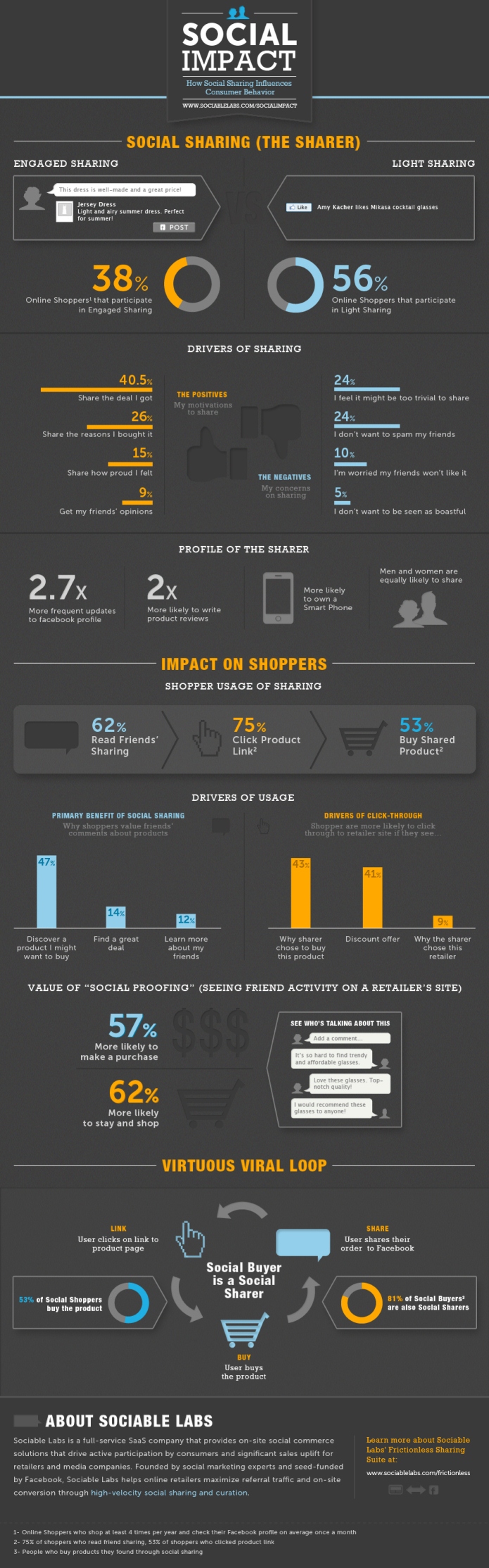
Following up from our post on the Social Impact Study 2012 we announced yesterday, we are publishing a summary infographic (below) with the key findings from this 1088-person consumer research study on the influence and impact of social sharing on consumer purchase.  

To download the full 34-page Social Impact Study 2012 Report, click below.

download_1


Sociable Labs SOCIAL IMPACT STUDY 2012 Infographic Summary


To download the full Social Impact Study 2012 Report, click the link below:

download_1


Social Impact Study 2012: Social Sharing as Helpful as Google Search in Shopping


Today, we are publishing a new consumer research study called Social Impact, based on a survey of 1088 online shoppers who use Facebook, about the influence and impact of social sharing (sharing comments about products with friends) on consumer purchase.  The survey, conducted between January 15 and February 8, 2012, looked into the minds of online shoppers to reveal how they view social sharing and how it fits into their shopping and purchase decision making process.  

We included many of the questions we’ve received from retailers and media companies about consumer behavior and motivation as it relates to social sharing, including:

  • What percentage of consumers take action on social sharing?
  • How does consumer-to-consumer sharing influence referral visits and purchases?
  • What drives shoppers to act on social sharing and how you can increase those actions?
  • Why do sharers share and what will increase this sharing?
  • What is the value of “Social Proofing” to consumers (seeing friend activity on a site)?

Here are the top takeaways from this study:

1. Social Sharing is a mainstream shopping activity for discovering what products to buy

 62% of online shoppers have read product-related comments from their friends on Facebook (example below). 

describe the image

The #1 value to shoppers in reading social sharing is that it “helps them discover a product they might want to buy”.


2. Social Sharing causes consumers to act

75% of shoppers who read social sharing comments have clicked on the product link in their friends’ Facebook posts, taking them to the product page on a retailer’s website.   53% of the shoppers who have clicked through to the retailer’s site have made a purchase.   

A core reason for these actions is that shoppers see social sharing as one of the most helpful tools for finding the right product to buy.

Helpfulness Chart resized 600


3. Once consumers are exposed to positive social sharing experiences, it creates a virtuous cycle of social sharing and purchase

81% of consumers who purchase products they learn about through social sharing are valuable social sharers themselves, thus creating a cycle of sharing and buying. 

Virtuous Cycle resized 600

4. “Social Proofing” – showing friends activities on a website - significantly increases shopper confidence in buying on that website

32% of visitors are more likely to stay and shop on a site that shows activities of shoppers who have purchased there, even when those shoppers are not their friends.  When the shared activities include the shopping behavior of the visitor’s friends, that number nearly doubles to 62%.

With respect to purchase, 57% of shoppers are more likely to purchase on a site that shows their friends who have purchased on that site.

Social Proofing resized 600


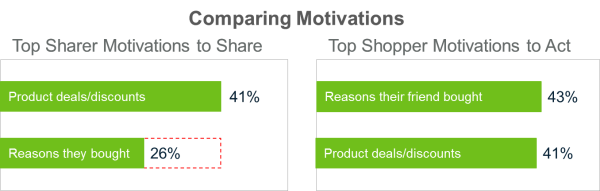
5. A key to maximizing the traffic and sales from social sharing is to match the motivations of sharers to share with the motivations of shoppers to act

When comparing sharer and shopper motivations, a key takeaway from our study is to encourage sharers to include the reasons they bought the product, as this is the strongest motivator for shoppers to act. 

Comparing Motivations resized 600


Study Conclusions

The Social Impact Study validates that consumers are highly influenced by their friends in considering what products to buy.  And that social sharing is a major source of product discovery for a significant percentage of consumers.  If you haven’t already incorporated social sharing applications into your ecommerce experience, we recommend that you do. 

To drive significantly higher-velocity sharing, you should consider leveraging Facebook’s Timeline Apps initiative.  To learn about our  “All-in-one Social Sharing and Curation Suite – EverShare™”, please click here.


download_1


Announcing First All-in-One Frictionless Sharing Suite: EverShare(tm)


Today, we launched a new solution called EverShare™ - the first all-in-one Frictionless Sharing and Curation Suite.  It’s a mouthful, for sure.  That’s because it represents the convergence of two very significant trends…

  1. Facebook’s Frictionless Sharing initiative, also referred to as Open Graph, and
  2. Social Curation, spearheaded by online sites like Pinterest and Fab.com

EverShare Gallery Feature SHORT

EverShare's "Gallery" Social Curation Feature

We already know that consumer-to-consumer sharing on ecommerce sites has proven to drive significant uplift in referral traffic, converting at much higher rates than other social media marketing efforts (e.g. 250-300 percent higher than Facebook Fan Page or Twitter programs for our social sharing applications).  The more sharing the more uplift.  

ShareSwitch Featuer for User Sharing and Privacy Controls


But not everyone who wants to share has time to initiate it.  In other words, there’s “friction” in the system.  And Facebook’s Frictionless Sharing initiative addresses this friction upfront by allowing shoppers to authorize certain on-site activities to be shared automatically on their Timelines and Tickers. 

EverShare provides all the functionality needed to take advantage of this initiative, including clear user controls over sharing settings at all times, and a library of social sharing applications that effectively engage users to share that very first time.

 (image to the left) EverShare's "ShareSwitch" User Controls


At the same time, the dramatic rise of socially-curated sites such as Pinterest and Fab.com has demonstrated the power of social curation to merchandise products and motivate user sharing in record numbers.  We provide the social curation and merchandising functionality in EverShare to capture this momentum on your ecommerce site.

If you are attending Etail West in Palm Springs, February 27 - March 1, 2012, stop by our booth (#25) to get a demonstration.  In addition to learning more about EverShare, you will get a just-completed 1088-person consumer research study - "Social Impact: How Consumers See It".

Facebook-Connected Shoppers Are 9 Times More Likely to Share Content with Friends


Today, more and more retailers are integrating social features into their ecommerce sites to create a more personalized shopping experience and drive increased referral traffic and sales.  A common question we hear from retailers considering Facebook Connect and Facebook Timeline applications is “what is the benefit of a ‘Facebook-Connected’ user?”  And, specifically, “is there on-going value created by a Facebook-Connected user?”

To answer this, we launched a study to measure the click-through rates and share rates of shoppers who were presented with a range of social sharing applications on retailer websites.  Our study found that returning Facebook-Connected users click on social applications and share content with their friends 9 times more often than non-Connected shoppers.   We certainly expected a higher propensity for sharing for Connected users, but we were surprised by the magnitude of this difference.

Facebook-Connected users are 9x more likely to engage with social features and share with friends.

What does it mean to be a Facebook-Connected user?

When online shoppers “connect” to ecommerce sites using Facebook Connect, they grant retailers access to information about themselves, such as lists of their friends, likes, and interests.  This information then allows retailers to offer social applications and more personalized shopping experiences.  There are two paths to becoming a Facebook-Connected user.  First, a shopper can login through a social login alternative, such as the “Login with Facebook” button.   This method gives the shopper a convenient way to login to a retailer site and also converts them to a Facebook-Connected user.  Second, a shopper can click on the call-to-action (CTA) for a social feature that requires information from the shopper’s Facebook account.

The two methods of becoming a Facebook-Connected user: 1) social login, 2) engaging with a Facebook-Connect-based feature.

The Study

To measure the benefit of Facebook-Connected users, we grouped users into two buckets based on Facebook login status:  (1) users who are logged in with Facebook Connect and (2) users who are not.  (As mentioned in a prior blog post, the login status is pulled directly from Facebook through an API called FB.getLoginStatus()). We then analyzed the rate at which individuals in these two groups (1) clicked on the main call-to-action, and then (2) shared content with their friends on Facebook.

The total data set is comprised of over 1.35 million CTA clicks on 42 different social sharing applications that occurred between October 2010 and January 2012.

Results

This study yielded two important learnings for us:

1)      Facebook Connected users are 9 times more likely to engage with on-site social sharing features (i.e. click on a call-to-action button for a social sharing application).

2)      Facebook Connected users are also 9 times more likely to complete the sharing process and send product/offer content to their friends on Facebook.

Conclusions

Based on our results, Facebook Connected users provide significant on-going value to retailers, as these users continue to engage and share at very high rates on return visits.  Given this fact, the natural conclusion is that retailers should find engaging social experiences that motivate shoppers to connect, driving significantly higher LTV through on-going new customer referrals.

Beyond adding Like buttons and other social sharing features, you should consider adding a social login alternative to your site.  Plus, consider adding the number “Facebook Connected Users” as a key performance indicator for your social strategy.

With those takeaways in mind, we’re going to get back to building engaging social features that will help you maximize these metrics!

Four Frequent Mistakes in Social Marketing


Any retailer swimming in the social media waters the past few years has heard the word "engagement" a million times, and for good reason. Engagement is key in driving word-of-mouth endorsements. However, engagement and word-of-mouth are really a prelude to the ultimate goal of driving increased sales.

The problem with most social engagement strategies is they don't actually increase sales. In fact, Forrester's recent State of Retailing Online study (SORO) found that 62 percent of retailers' social marketing return on investment is still unclear. As retailers look beyond engagement to ROI from their social strategies in 2012, here are four mistakes to avoid:

1. Counting on Facebook fan pages to drive sales. Retailers have invested a lot of time and money into Facebook fan pages, trying to build a large fan base and engage them with weekly posts and promotions. This contradicts the true spirit of social — i.e., connecting with and empowering consumers. The socially empowered consumer now expects input and advice from peers, not from manufacturers or retailers. It should come as no surprise that traffic from Facebook fan pages isn't driving sales.

Recommendation: Capitalize on your existing ecommerce investments by engaging your website visitors with social features that cause consumer-to-consumer sharing. Word-of-mouth sharing will help drive traffic to your ecommerce site, where you're best equipped to convert it.

2. Relying on the 'Like' button to drive sharing. Early attempts to drive consumer-to-consumer sharing on ecommerce sites centered on the Facebook "Like" button. The click-through rate has been extremely low as there's no clear reason or benefit for consumers to like a product while shopping. What problem does that help them solve for them?

Recommendation: Provide engaging social experiences tailored to your target consumers that present compelling reasons for them to share with friends. Prioritize solutions that leverage user interaction data on your site as well as full social graph data about the user and their friends on Facebook. This will ensure you present the most relevant experiences at each step in the shopping process.

3. Waiting for a well formulated social roadmap to start. While the potential revenue that on-site social applications can generate is huge, waiting to create the ideal social roadmap may actually reduce your chance of success. It's hard to predict what will work best with your customers and your product categories. To make matters worse, while you're busy planning and building consensus across the company, your competitors can dive in and start getting real customer feedback to know what really works.

Recommendation: If you don't already have Facebook-trained engineers and product managers on staff, you may want to partner with a social commerce vendor regardless of your plan so you can get started quickly and get that feedback. You should pick a partner that allows you to easily test and improve upon different social experiences across your site (and yes, Sociable Labs does offer that capability). Because social commerce is still in its infancy, rapid experimentation and testing is key to generating the highest returns.

4. Looking for the social 'silver bullet.' Social technologies are evolving fast (as is consumer social behavior). Forrester's recent SORO study shows there's no proven solution in social marketing, though efforts to integrate social features on ecommerce sites have proven to work the best so far for growing sales.

Recommendation: Look for a social solution that provides a wide range of on-site social experiences explicitly aimed at increasing the metrics that matter most, namely referral traffic and site-wide conversions. Customize these experiences to your specific products and users. Solutions with built-in A/B testing capabilities ensure the greatest opportunity to know what works for your business and what doesn't, allowing you to optimize for the greatest user participation and overall lift in sales.

The Top 5 Social Commerce Disruptors in 2012


2011 was a big year for ecommerce and 2012 promises to be even bigger as social commerce continues to emerge as a key source of traffic and sales for online retailers. Here are the top five trends in social commerce that I predict will have the most impact in the coming year:

Going beyond the "like": To gain greater value from the Facebook social graph, e-commerce sites will begin to allow visitors to do more than just "like" a product. At the most recent f8 Developer Conference, Facebook announced its plans to enable more types of user actions to be shared, such as "read," "watched" and "listened." In 2012, e-commerce sites will begin to define their own social actions, allowing consumers to indicate what they've bought or reviewed, or even indicate what items they are shopping for. Given that 50% of visitors to e-commerce sites are logged into Facebook while shopping, these types of social features will prove to be popular with consumers in 2012.


Platforms open wide: One of the biggest inhibitors to integrating social into the e-commerce experience over the past two years has been the technical challenge. Vocal demand from retailers has driven most of the major e-commerce platform providers to adapt, making their platforms much easier to integrate with third party services. eBay's X.commerce announcement is the most visible example of this trend, but every major e-commerce platform has made social integration a big part of its roadmap in 2012.


More deals, every day: 2011 was the year of the local daily deal, led by Groupon and Living Social, amongst others. The daily deal phenomenon proved that consumers don't want to miss out on a phenomenal deal, even if they had little-to-no purchase intent for the item or service being offered. Online retailers were quick to realize that the Groupon model could be applied to their own websites, and I predict that this trend will only accelerate in 2012. The daily deal will become a mainstay of the e-commerce environment for years to come.


Celebrity-driven marketing: Our celebrity-driven culture extended into online retailing in a big way in 2011, and we'll be seeing plenty more in 2012. After several years of building Facebook fans and Twitter followers, social media-savvy celebrities became a key asset to the marketing strategies for many online brands. The success of ShoeDazzle, which rode Kim Kardashian's popularity, set an example for the industry. In 2012, we'll see more sites use celebrity muscle to push traffic to retail sites — like Fab.com, which got Demi Moore to tweet about some of its early sales, and BeachMint, which co-presents products from Kate Bosworth, the Olsen sisters and Jessica Simpson.


Shopping less but spending more: Shoppers with more cash than time will be courted by sites that offer personalized shopping services, digging up only the deals and the products that the shopper will jump on. Services like Shop It To Me act as virtual personal shoppers, saving their members the hassle of scouring sites for deals. Services that rent products, like Rent The Runway, will unlock new ways of consuming products. New forms of shopping with social twists will continue to spread in popularity fueled by strong word of mouth via social networks.

All Posts